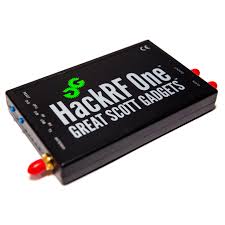
HackRF One – Software Defined Radio for RF Analysis and Transmission
Overview
The HackRF One is a powerful Software Defined Radio (SDR) platform that allows you to transmit and receive radio signals from 1 MHz to 6 GHz, making it the ultimate tool for wireless security research, RF protocol analysis, and spectrum monitoring. Unlike receive-only SDRs, the HackRF One features full-duplex operation with simultaneous transmit and receive capabilities, enabling real-time signal analysis and replay attacks. Developed by Michael Ossmann and manufactured by Great Scott Gadgets, the HackRF One is widely used by security researchers, radio enthusiasts, and penetration testers for analyzing everything from garage door openers and key fobs to cellular networks and satellite communications. The device features a 20 MSPS sample rate with 8-bit ADC/DAC, allowing capture of wideband signals including WiFi, Bluetooth, Zigbee, GSM, LTE, GPS, and countless proprietary protocols. The open-source hardware design and active community provide extensive documentation, tutorials, and ready-to-use tools including GNU Radio flowgraphs, Inspectrum signal analysis, and Universal Radio Hacker for protocol reverse engineering. Common security testing applications include testing RFID/NFC systems at different frequencies, analyzing IoT device communications, performing spectrum surveys for rogue transmitters, replaying captured RF signals for penetration testing, and researching wireless protocols. The HackRF One connects via USB and works with software like GQRX, SDR#, and Inspectrum on Windows, Linux, and macOS. Essential for serious RF security research and wireless penetration testing.
Pros & Cons
Pros
- 1 MHz to 6 GHz frequency range - widest coverage
- Full-duplex transmit and receive simultaneously
- 20 MSPS sample rate with 8-bit resolution
- Open-source hardware with active community
- Supports GNU Radio for advanced signal processing
- Compatible with Windows, Linux, macOS
- Analyze WiFi, Bluetooth, Zigbee, GSM, LTE, GPS
- Replay attack capabilities for security testing
- Portable USB-powered design
- RF spectrum analysis and monitoring
- Protocol reverse engineering with URH
- IoT device communication analysis
- Testing RFID/NFC systems at various frequencies
- Spectrum survey for rogue transmitters
- Extensive documentation and tutorials
- Upgradeable firmware via USB
- SMA antenna connectors (standard)
- Built-in filtering and amplification
- Ideal for OSINT and SIGINT operations
- Affordable compared to professional SDR equipment
Cons
- Steep learning curve for RF beginners
- Requires external antennas (not included)
- Limited to 20 MSPS bandwidth
- 8-bit ADC lower resolution than professional SDRs
- No built-in GPS for time synchronization
- USB power may be insufficient for TX mode
- Transmission is ILLEGAL without proper license
- Software setup can be complex on Windows
- Limited dynamic range compared to high-end SDRs
- Requires understanding of RF and DSP concepts
- No built-in display or controls (PC required)
- Can interfere with nearby electronics when transmitting
- Some frequencies blocked by hardware filters
Ready to get started with HackRF One – Software Defined Radio for RF Analysis and Transmission?
Click below to visit their official website and get the best deal.
Visit Official Website →